Human Touch in the Age of AI
- Advanced Neuromuscular Therapy Program
- Associate of Applied Science Degree Program
- Core Massage Therapy Training Program
- Health & Wellness
The Science Behind What Technology Cannot Replicate
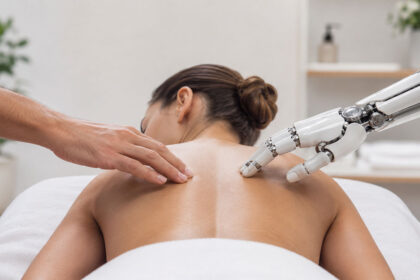
Human Touch in the Age of AI | The Science Behind What Technology Cannot Replicate
Content Summary
In this final installment of our series on artificial intelligence and bodywork, we explore why skilled human touch cannot be reduced to mechanical pressure. Supported by neuroscientific, social, and clinical research, this article details how affective touch, nervous system regulation, therapeutic alliance, and real-time clinical reasoning separate educated massage therapists from automated technology.
- Discriminative vs. Affective Touch: How the nervous system distinguishes between mere mechanical input and emotional, relationship-based contact.
- The Power of Context & Safety: Why vagal stimulation, threat reduction, and the therapeutic alliance shape how the body interprets touch.
- Emotional Communication: Research demonstrating that human touch carries distinct social and emotional meaning that algorithms cannot express.
- Data vs. Clinical Interpretation: Why detecting tissue data is fundamentally different from adapting to subtle shifts in breathing, guarding, and client intent in real time.
Our three-part series centered around the primary question, “Is Massage Therapy and AI-Proof Career?” began by explaining why human touch, clinical reasoning, and connection still matter. In the second post, “Human Touch vs. Mechanical Touch: What the Science Really Says,” we discovered how the nervous system responds to hands-on care and why skilled touch is still relevant in the age of AI. Now we explore the science behind what technology cannot replicate.
Artificial intelligence is changing how people gather information, make decisions, track progress, and interact with health and wellness tools. In massage therapy, it is reasonable to imagine a future where AI helps clients understand symptoms, suggests self-care routines, supports documentation, analyzes movement data, or even guides robotic/manual devices.
That future may be closer than many people realize.
But the deeper question is not whether AI can assist massage therapy. It can. The real question is whether AI can fully replicate the power of skilled human touch.
The answer is far more complicated.
Massage therapy is not valuable simply because a therapist can apply pressure. Pressure can be produced by a massage gun. Compression can be created by a foam roller. Algorithms can process information. Sensors can gather data. Robotic systems may eventually become more precise, more responsive, and more widely available.
But human touch is not just pressure.
Human touch is sensory. It is emotional. It is relational. It is adaptive. It is contextual. In massage therapy, skilled touch becomes even more powerful when it is guided by education, clinical reasoning, communication, and the ability to respond to the person in front of you in real time.
The challenge for AI is not replicating pressure.
The challenge is replicating presence, meaning, safety, trust, and clinical reasoning through touch.
Touch is Not Just Mechanical Input
One of the most common misunderstandings about massage therapy is that it is primarily mechanical; pressure applied to muscle, fascia, and connective tissue. If that were the whole story, then the future of massage therapy would be easy to predict. Machines would eventually apply pressure more consistently, for longer periods of time, and perhaps with better data than a human therapist.
But massage and touch are not that simple.
Research on effective touch helps explain why. McGlone, Wessberg, and Olausson describe touch as having more than one dimension:
“Touch has another dimension, providing not only its well-recognized discriminative input to the brain, but also an affective input.”
That distinction matters. Discriminative touch helps the brain identify physical qualities such as pressure, vibration, location, and movement. Affective touch contributes to how contact feels emotional: safe, comforting, unpleasant, threatening, reassuring, or supportive. This means touch is not only about what contacts the body. It is also about how the nervous system interprets that contact.
This is where the comparison between human touch and AI becomes more meaningful. A device may apply mechanical input. A therapist applies input within a human relationship.
A skilled therapist’s hands are not only doing something to the tissue. They are also listening. They are assessing tone, resistance, guarding, temperature, breath, and response. They are adjusting based on what the client says, what the body does, and what the therapist feels.
AI may become excellent at detecting data. Human touch works with meaning.
The Nervous System Responds to Context
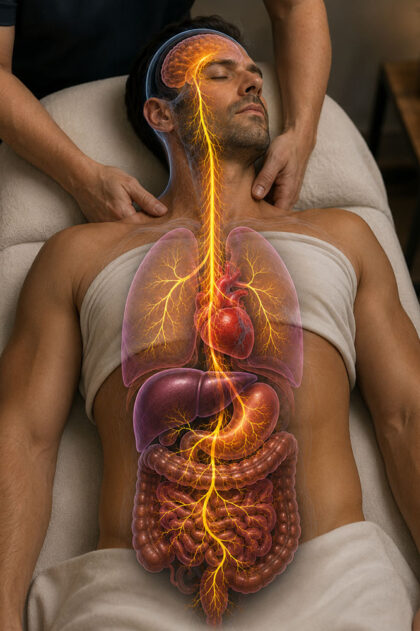
Illustrative Overlay of the Vagus Nerve
Pain, tension, guarding, and relaxation are not just tissue events. They are nervous-system experiences. The body does not process touch in isolation. It interprets touch through context.
That context includes consent, trust, expectation, previous experience, therapist confidence, tone of voice, pace, pressure, room environment, and the client’s sense of safety.
This is one reason skilled massage therapy cannot be reduced to “rubbing muscles.” The client’s nervous system is constantly asking: Is this safe? Is it helpful? Is it threatening? Do I need to protect myself? Can I let go and relax? Can I trust this touch?
Massage research supports the idea that touch can influence more than local tissue. Tiffany Field’s review on massage therapy effects explains, “(T)he stimulation of pressure receptors leads to increased vagal activity…” The vagus nerve is a major pathway of the parasympathetic nervous system, often associated with rest, digestion, heart rate regulation, and recovery. When vagal activity increases, the body may shift toward a calmer, more regulated state. This helps explain why skilled massage can feel different from simple mechanical pressure: the body is not only receiving force; the nervous system is interpreting and responding to that contact.
This does not mean massage should be described as a cure-all, and it does not mean every session produces the same effect. It means massage deserves to be understood as a nervous-system-relevant intervention, not simply a mechanical tissue technique.
That is an important challenge for AI. A machine may be able to apply a programmed amount of pressure. But skilled therapeutic touch is not just about pressure dosage. It is about when to increase, when to soften, when to pause, when to change direction, when to ask a question, and when the client’s body is signaling that the plan needs to change.
Human Touch Carries Emotional and Social Meaning
Human touch can communicate without words. A steady hand can reassure. A rushed hand can create tension. A confident hand can help a client feel safe. An inattentive hand can make even technically correct touch feel disconnected.
This matters in massage therapy because the therapist’s hands are not neutral tools. They are part of a larger therapeutic interaction.
Research on social touch supports this broader concept. Hertenstein, Keltner, App, Bulleit, and Jaskolka found that participants could decode several emotions through touch at much-better-than-chance levels, including anger, fear, disgust, love, gratitude, and sympathy.
The relevance to massage therapy is not that therapists are intentionally “sending emotions” through treatment. The relevance is that human touch caries social and emotional information beyond pressure alone.
That is one of the hardest things for AI to replicate. AI may be able to estimate pressure, speed, temperature, and tissue stiffness. But human touch also carries intent, care, pacing, responsiveness, and relational meaning. The client is not only receiving contact. The client is experiencing the person delivering the contact.
In a profession built around therapeutic touch, that distinction is not minor. It is central.
Safety Changes How Touch is Received
Supportive human touch can influence how the nervous system responds to threat. A frequently cited fMRI study by Coan, Schaefer, and Davidson examined hand-holding during threat of electric shock. The authors found: “Hand-holding conferred a basic level of regulatory influence on the neural response to threat cues.” This was not a massage therapy study, so it should not be overextended. But it supports an important principle; touch is processed through relationship and context. In that study, neural threat responses differed depending on whether participants held a spouse’s hand, a stranger’s hand, or no hand.
For massage therapy, the takeaway is not that all touch automatically reduces threat. It does not. Poorly delivered, poorly explained, or poorly consented touch may increase threat.
The takeaway is that human touch can be deeply contextual. Trust matters. Relationship matters. The receiver’s perception matters.
AI may eventually become more responsive. Robotic systems may become softer, warmer, and more technically advanced. But the nervous system does not only ask, “what pressure is being applied?” It also asks, “who or what is touching me, why, and do I feel safe?”
That is a much harder problem to solve.
Touch Interventions Have a Growing Evidence Base
The value of touch is not only philosophical. A large 2024 systemic review and multi-variated meta-analysis published in Nature Human Behaviour examined the physical and mental health benefits of touch interventions. The authors conducted a pre-registered review that included 137 studies in the meta-analysis and 75 additional studies in the systematic review, representing 12,966 participants.
The review found that touch interventions were associated with benefits across several outcomes, with notable relevance for pain, anxiety, and depression. This does not mean every type of touch works the same way. It also does not mean massage therapy should be presented as a replacement for medical or mental health care. But it does support a more serious view of touch as a meaningful contributor to human well-being.
That matters for massage therapy education. If touch can influence physical and mental-health-related outcomes, then therapists need to understand that their work is not casual. It requires training, ethics, boundaries, communication, and the ability to recognize when massage is appropriate and when referral and collaboration are needed.
Human touch is powerful. That is exactly why it needs to be educated.
AI Can Detect Data, but Therapists Interpret Response
AI will likely become very useful in massage therapy. It may help with scheduling, documentation, client education, intake analysis, research summaries, exercise reminders, and pattern recognition. It may help therapists organize information more efficiently. It may help clients stay engaged between sessions.
That should not be dismissed.
But massage therapy happens in real time, with a real person, in a living body.
A client may say the pressure is fine while their breath becomes shallow. A shoulder may subtly guard. The body may resist a technique that looked appropriate during assessment. A client’s history may change the clinical reasoning. A therapist may discover that the most important intervention is not more pressure, but a different pace, a different explanation, a different goal, or a referral.
This is not just data collection. That is interpretation.
The therapist is constantly integrating information:
- Intake history
- Posture and movement
- Palpation
- Client goals
- Pain behavior
- Breathing
- Guarding
- Tissue response
- Communication
- Contraindications
- Emotional state
- Scope of practice
- Clinical judgement
AI may assist that process; but assistance is not the same as replacement.
Human-to-Human Touch is Complex
Even touch researchers acknowledge the difficulty of reproducing natural human touch in controlled settings. A review on naturalistic stimuli in touch research notes, “Such stimuli are very different from highly complex naturalistic human-to-human touch interactions.” The authors explain that touch neuroscience often relies on robotic or controlled devices, but natural human-to-human touch is much harder to study because of the complexity of skin mechanics and real social interactions.
That quote is especially relevant to the AI conversation. If researchers find natural human touch difficult to reproduce in controlled laboratory conditions, then massage therapy represents an even greater challenge. Therapeutic massage includes pressure, stretch, glide, warmth, rhythm, direction, tissue response, client expectation, consent, emotion, trust, and clinical reasoning.
Human touch is not one variable, it is many variables acting as one.
That does not mean technology will never become more sophisticated. It will. But the full experience of skilled therapeutic touch is far more complex than applying pressure to soft tissue.
The Therapeutic Relationship is Part of Care
A massage therapist is not just a pair of hands. The therapist is part of the therapeutic environment.
The way a therapist listens, explains, asks permission, adjusts pressure, respects boundaries, and collaborates with the client changes the experience of care. Research in physical therapy for chronic musculoskeletal pain supports the importance of this broader relationship. Kinney and colleagues concluded, “A strong TA may improve pain outcomes.” TA refers to therapeutic alliance. Massage therapy is a distinct profession, and this research should not be treated as direct proof that every massage outcome depends on therapeutic alliance. But it does support a broader and very relevant point: in musculoskeletal care, the relationship between practitioner and client can matter.
For massage therapy, that is not surprising. Clients are not passive machines receiving inputs. They are people with histories, beliefs, worries, goals, and lived experiences. The therapeutic relationship helps shape how care is received, understood, and integrated.
AI can simulate communication. But trust is not built by words alone. It is built through consistency, responsiveness, consent, respect, and the client’s felt sense that the therapist is paying attention.
The Future is Not Human Touch Versus Technology
The future of massage therapy should not be framed as humans against machines.
That is too simplistic.
Massage guns, foam rollers, wearable devices, AI platforms, and future robotic systems may all have a place. Some tools may help clients maintain progress between sessions. Some may support recovery. Some may improve access. Some may help therapists work more efficiently.
Technology is not the enemy of massage therapy.
The real danger is reducing massage therapy to something technology can easily imitate.
If massage therapy is defined only as pressure, then it becomes more vulnerable to replacement. If massage therapy is defined as memorized routines, then it becomes easy to automate. If massage therapy is defined as “working on tight muscles,” then it becomes easy to oversimplify.
But that is not the highest expression of this profession.
Massage therapy becomes more valuable when it is grounded in anatomy, physiology, pathology, assessment, palpation, pain science, communication, ethics, and clinical reasoning.
Human touch becomes harder to replace when it is educated.
The Skill Technology Can’t Replace
AI may become better at processing data. Robotic systems may become better at delivering pressure. Devices may become more personalized, more responsive, and more widely accepted.
But massage therapy is not valuable because humans can simply apply pressure.
Massage therapy is valuable because skilled massage therapists can interpret what they feel, adapt to what they observe, communicate with the person in front of them, and deliver touch within a relationship of trust.
The future of massage therapy will not be protected by rejecting technology. It will be strengthened by developing therapists who can do what technology cannot fully replicate: think critically, assess thoroughly, adapt skillfully, communicate clearly, and deliver human touch with knowledge and care.
Because the question is not whether AI can apply pressure.
The question is whether AI can understand what the pressure means to this person, in this moment, in this body, with this history, this nervous system, this pain experience, and this goal.
That is where skilled massage therapy will always matter.
Human touch is not becoming obsolete.
When backed by education, clinical reasoning, and therapeutic presence, human touch is becoming more valuable and powerful.
At NHI, students gain that education through the Core Massage Therapy Program, where they build foundational knowledge and hands-on skills. For those ready to go deeper, the Advanced Neuromuscular Therapy Program provides focused training in assessment, clinical reasoning, pain patterns, neuromuscular techniques, and more advanced therapeutic decision-making. For students seeking a broader academic path, NHI’s Associate of Applied Science Degree Program offers an opportunity to continue developing as a more educated, capable, and future ready professional.
Common Questions About Human Touch in the Age of AI
Q: Can artificial intelligence or robotic devices replace massage therapists?
A: While AI and robotics can simulate mechanical pressure or analyze movement data, they cannot replicate the affective, relational, and contextual dimensions of human touch. Skilled massage therapy relies on real-time clinical reasoning, therapeutic alliance, emotional safety, and physical presence—elements that technology cannot reproduce.
Q: What is the difference between discriminative touch and affective touch?
A: Discriminative touch provides physical data to the brain, such as location, intensity, and pressure. Affective touch engages emotional and social pathways, signaling safety, reassurance, or comfort. Human massage therapy integrates both, allowing the nervous system to process touch beyond mere force.
Q: How does massage therapy influence the nervous system?
A: Moderate pressure massage stimulates pressure receptors that increase vagal nerve activity, encouraging the body to shift into a parasympathetic state (rest, digestion, and recovery). This nervous-system-level response helps lower threat perception, anxiety, and muscular guarding.
References
- Coan, J. A., Schaefer, H. S., & Davidson, R. J. (2006). Lending a hand: Social regulation of the neural response to threat. Psychological Science.
- Field, T. (2010). Moderate pressure is essential for massage therapy effects. International Journal of Neuroscience, 120(5), 381–385.
- Hertenstein, M. J., Keltner, D., App, B., Bulleit, B. A., & Jaskolka, A. R. (2006). Touch communicates distinct emotions. Emotion, 6(3), 528–533.
- Kinney, M., Seider, J., Beaty, A. F., Coughlin, K., Dyal, M., & Clewley, D. (2020). The impact of therapeutic alliance in physical therapy for chronic musculoskeletal pain: A systematic review of the literature. Physiotherapy Theory and Practice.
- Maallo, A. M. S., Duvernoy, B., Olausson, H., & McIntyre, S. (2022). Naturalistic stimuli in touch research. Current Opinion in Behavioral Sciences.
- McGlone, F., Wessberg, J., & Olausson, H. (2014). Discriminative and affective touch: Sensing and feeling. Neuron, 82(4), 737–755.
- Packheiser, J., et al. (2024). A systematic review and multivariate meta-analysis of the physical and mental health benefits of touch interventions. Nature Human Behaviour, 8, 1088–1107.
About the Author

Phil Okazaki
Phil Okazaki is a massage therapist, educator, and an industry volunteer with 25 years of experience in the field and 17 years of teaching experience.
In addition to his educational experience of developing curriculum and mentoring therapists, he has several years of volunteer experience with the American Massage Therapy Association including 4 years as President of the AMTA California Chapter.
He has dedicated his career to elevating standards in massage therapy education and supporting the growth of the profession as an integral component of healthcare.
Phil is the Advanced Neuromuscular Therapy Program Manager at National Holistic Institute.
Get the details on how to pursue a career in massage therapy and neuromuscular therapy with National Holistic Institute. Complete this form to connect with an admissions representative today.