Is Massage Therapy an AI-Proof Career?
- Advanced Neuromuscular Therapy Program
- Associate of Applied Science Degree Program
- Core Massage Therapy Training Program
- NHI Life
Why Human Touch, Clinical Reasoning, and Connection Still Matter
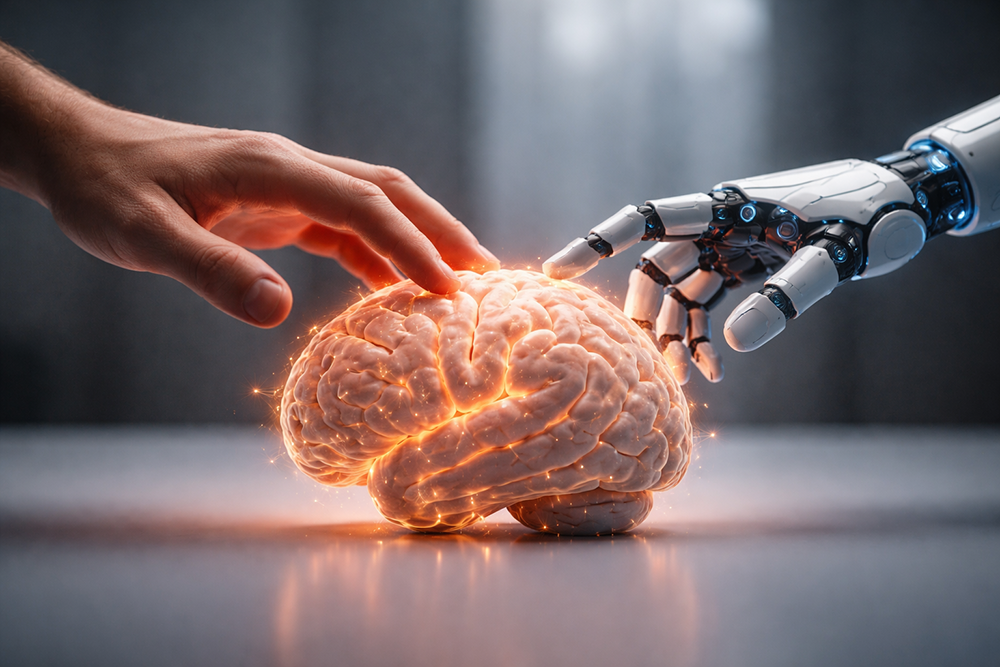
Is Massage Therapy an AI Proof Career?
Content Summary
As automation transforms the global workforce, the massage therapy profession stands out as a uniquely resilient career path. This article examines why the “human element” remains irreplaceable through:
- The Nuance of Touch: Why robots lack the tactile sensitivity required for complex clinical work.
- Expert Clinical Reasoning: The role of an Advanced Neuromuscular Therapist in creating customized treatment plans that AI cannot replicate.
- The Therapeutic Alliance: How the trust and empathy shared between therapist and client drive superior health outcomes.
A question I’ve been hearing more and more from students, therapists, and even experienced professionals is this…is massage therapy an AI-proof career?
It’s a solid question and an important point to ponder as we see and hear of people losing jobs to AI. In massage and healthcare, we’re already seeing artificial intelligence write documentation, analyze movement, and assist in clinical decision making. Automated massage systems are entering gyms, hotels, and wellness spaces. Technology is continuing to advance quickly, and it isn’t slowing down.
It’s important to look one step beyond massage being AI-proof; it’s important to start to reframe the discussion into how will AI continue to influence the profession and, even more importantly, what happens to the therapists in all this change?
What AI Can Do – and It’s Improving Quickly
Artificial intelligence has already proven valuable in areas that support healthcare and wellness professionals. It can:
- Summarize and organize documentation
- Analyze patterns in posture and movement
- Assist with client intake and information processing
- Provide rapid access to research and educational content
According to McKinsey & Company, generative AI could automate 60%-70% of the activities employees currently spend time on, particularly those involving structured tasks and data processing. For massage therapists, this means AI will likely continue to streamline:
- Documentation
- Administrative workflows
- Access to continuing education
Ignoring these advancements would be a mistake. But assuming they replace the therapist entirely is equally misguided.
Where AI Begins to Fall Short
AI performs best when tasks are predictable, structured, and based on clear rules. AI struggles when:
- Context is unclear or constantly changing
- Feedback is non-verbal or nuanced
- Real-time adaptation is required
These are not the fringes of massage therapy; these are some of the foundational aspects of the profession.
As “Explain Pain Supercharged” explains, “Pain is a protective output of the brain, not a measure of tissue damage.” This single concept highlights a major limitation of purely mechanical or algorithmic approaches. Pain is influenced by perception, context, and a sense of safety, not just tissue condition. That complexity is where skilled therapists operate every day.
Touch is Not Just Mechanical
After working with thousands of clients and teaching hundreds of therapists, one thing is clear. Touch is not just something you do. It’s something you interpret.
Skilled palpation is not simply applying pressure. It is a trained sensory skill developed through experience, clinical reasoning, and repetition.
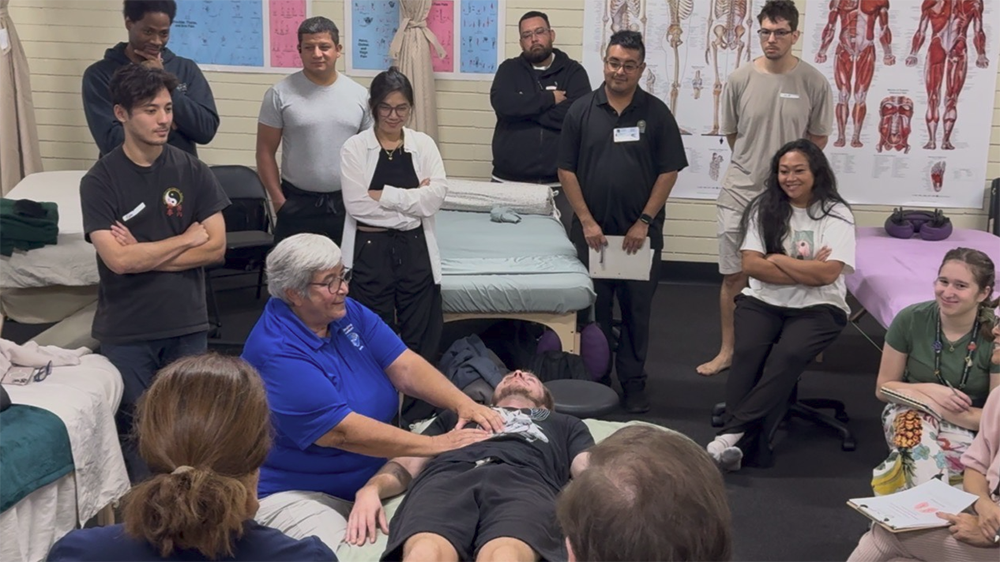
ANMT Program Founder Cynthia Ribeiro Demonstrates Neuromuscular Therapy Techniques
As noted in Travell, Simons & Simons’ “Myofascial Pain and Dysfunction.” “Palpation is the most important method of identifying myofascial trigger points and requires considerable practice to develop reliability.”
That level of reliability comes from time, exposure, and training; not from algorithms. Technology can replicate pressure; it’s not currently able to replicate perception.
Human Connection is a Clinical Tool
- Human connection in manual therapy is often misunderstood as a “soft skill,” In reality, it is a clinical variable. Modern pain science consistently shows that outcomes are influenced by:
- Context
- Expectation
- Perceived safety
As Butler and Moseley noted, “Knowledge and understanding can change pain.” The therapist’s ability to communicate, build trust, and create a sense of safety directly influences how a client experiences pain and recovery. This is not separate from treatment. It is part of the treatment.
Where Every Therapist Starts…and Why That Matters
Every skilled therapist begins with the foundational education. Learning anatomy, developing proper body mechanics, and building initial palpation skills are not “basic” – they are absolutely essential. These foundational skills allow therapists to:
- Work safely
- Develop awareness
- Begin understanding how the body responds to touch
No advanced clinical reasoning exists without this foundation. The difference is not where someone starts; it’s how far they continue to develop those skills.
The Part We Can’t Ignore
Not all massage therapy is equally protected from change. Routine, protocol-based work, where the same techniques are applied regardless of the client, is already being replicated in basic forms through automation and consumer technology.
That does not mean the profession is disappearing.
But it does mean something important. How you practice matters more than ever. Therapists who rely solely on repetition may find increasing competition from scalable lower-cost alternatives. Therapists who assess, adapt, and think clinically operate in a different category all together.
The Real Divide: Technician vs. Clinician
The future of massage therapy is not defined by whether AI exists. It is defined by how therapists evolve with it. There is a growing distinction between:
- Technicians, who apply techniques
- Clinicians, who assess, interpret, and adapt
In “Principles of Athletic Training,” effective care is described as a process that must be continually adjusted based on the patient’s response. That level of adaptability requires:
- Knowledge
- Experience
- Decision-making
It is not easily automated.
Looking Ahead
AI will continue to evolve. It will become faster, more efficient, and more integrated into healthcare and wellness. But it will not replace the therapist who can:
- Assess, not just apply techniques
- Adapt in real time
- Interpret what the body is communicating
- Create a sense of safety and trust that influences outcomes
That therapist doesn’t compete with AI. They operate in a space AI hasn’t reached and may not reach for a long time. The future of massage therapy is not about avoiding technology. It’s about becoming the kind of practitioner technology cannot replace.
Discover Amazing Alumni who have work they love as Massage Therapists, Advanced Neuromuscular Therapists and Medical Massage Clinicians.
Want to dig deeper into the discussion around, “Is Massage Therapy AI-Proof?” To understand the biological science behind why humans win, read our deep dive on Human Touch vs. Mechanical Touch.
Common Questions About AI in the Massage Industry
Q: Is massage therapy likely to be replaced by AI?
A: While AI can automate administrative tasks like documentation and scheduling, it cannot replace the clinical reasoning, adaptive palpation, and human connection essential to massage therapy. Skilled therapists who operate as clinicians rather than technicians remain in high demand because they can interpret subtle physiological feedback that technology cannot.
Q: How is AI currently used in the massage industry?
A: AI is currently used to streamline healthcare workflows, analyze client movement patterns, and assist in clinical research. While automated massage chairs and robotic systems exist, they lack the ability to adapt in real-time to a client’s nervous system or provide the biological benefits of human-to-human touch.
Q: What makes a massage therapy career “AI-proof”?
A: A massage career is “AI-proof” when it is rooted in advanced clinical education. The ability to perform thorough assessments, understand complex pain science, and adjust techniques based on real-time sensory feedback (palpation) creates a level of care that current and future mechanical systems cannot replicate.
Bibliography
- Butler, D., & Moseley, L. (2017). Explain Pain Supercharged. NOI Group Publications.
- McKinsey & Company. (2023). The Economic Potential of Generative AI: The Next Productivity Frontier.
- Prentice, W.E. (2020). Principles of Athletic Training: A Guide to Evidence-Based Clinical Practice (18th ed.). McGraw-Hill.
- Trave, J.G., Simons, D.G., & Simons, L.S. (2018). Myofascial Pain and Dysfunction: The Trigger Point Manual (3rd ed.). Wolters Kluwer.
About the Author

Phil Okazaki
Phil Okazaki is a massage therapist, educator, and an industry volunteer with 25 years of experience in the field and 17 years of teaching experience.
In addition to his educational experience of developing curriculum and mentoring therapists, he has several years of volunteer experience with the American Massage Therapy Association including 4 years as President of the AMTA California Chapter.
He has dedicated his career to elevating standards in massage therapy education and supporting the growth of the profession as an integral component of healthcare.
Phil is the Advanced Neuromuscular Therapy Program Manager at National Holistic Institute.
Get the details on how to pursue a career in massage therapy and neuromuscular therapy with National Holistic Institute. Complete this form to connect with an admissions representative today.