NHI Studio City Grad and USAF Veteran Edith Harris on Becoming a Medical Massage Clinician
- Advanced Neuromuscular Therapy Program
- Amazing Alumni
- Associate of Applied Science Degree Program
- Core Massage Therapy Training Program
- NHI Believes
- Veterans
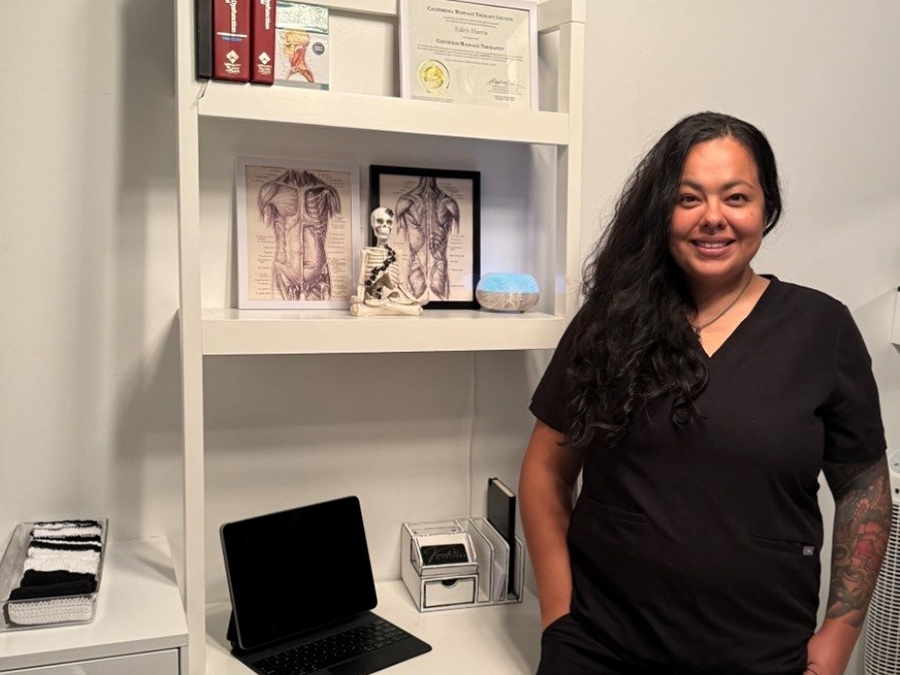
Edith Harris, USAF Veteran, NHI Studio City Grad and Owner of Knead Obscura in Thousand Oaks, CA
Content Summary
Edith Harris’s journey from the U.S. Air Force and the tech industry to clinical bodywork is a masterclass in resilience and specialized expertise. After almost walking away from her education, Edith returned to NHI Studio City to become a leader in the medical massage field. Her spotlight features:
- The Veteran’s “New Mission”: How a USAF Veteran used the GI Bill® to pivot from a career in data analysis to the science of human anatomy.
- The “System” of the Body: How Edith’s tech background allows her to view chronic pain like a computer system that can be “opened up” and understood.
- The Clinical Journey: The impact of completing the Core Massage Therapy, Advanced Neuromuscular Therapy (ANMT), and Associate of Applied Science (AAS) Degree Programs at NHI.
- Knead Obscura: Her private practice in Thousand Oaks specializing in complex cases, pre and post-surgical recovery, and scar tissue work.
The Phone Call I Almost Didn’t Answer
I didn’t come to massage school for the right reasons. I want to say that up front, because I think the honest version of a story is more useful than the polished one.
I was a veteran living with fibromyalgia, and I had recently left my office job because the pain had made it impossible to keep working. For my birthday, my husband gifted me a massage with my brother-in-law, who’s a massage therapist. While he was working on me, we talked about my pain, and he told me I should think about massage school.
He said he always encourages people with the time and means to do it, because you learn so much about your own body in the process. He didn’t know the GI Bill® paid me to go. So, when I found out I could get a monthly allowance to learn how to rub people for a living and get daily massages while I did it, I thought, how hard can it be?
Shelving the Dream
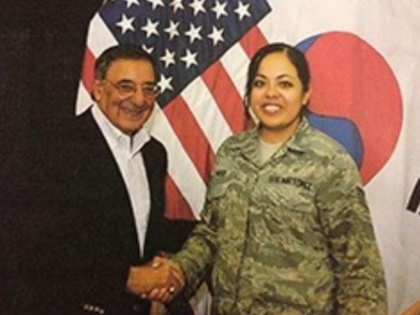
Edith Harris Receiving a Challenge Coin from Former Secretary of Defense Leon Panetta during his visit to South Korea in 2012
The truth I didn’t see at the time was that the GI Bill® was a permission slip, not a reason. I had wanted to be a massage therapist before. Touch is my love language. But years earlier, my mom had warned me away from it.
She told me that female therapists deal with inappropriate clients, and when they push back, the client complains first, and the therapist is the one who gets fired and possibly ends up with a record. That scared me. I shelved the idea so completely I forgot I’d ever had it. My brother-in-law handed it back to me without knowing.
I picked NHI because the GI Bill® covered it and because the program was eight hundred hours instead of the California minimum of five hundred. Longer felt better. More serious. I didn’t yet understand what I was walking into.
Massage school was the hardest thing I had ever done. I had spent my whole life avoiding anatomy. I came from tech, IT, data analyst work, building my own computers. I knew nothing about the body, and suddenly I was supposed to know all of it. I was discouraged in a way that surprised me.
The Pattern of Quitting
Then life got harder. There was a serious crisis at home that needed me, and I started missing classes. My instructor, Casey, had already sat me down once before and told me, clearly, that I couldn’t miss another minute.
But I did. I missed more. And when he told me I was out, I cried and I begged. I’ll be honest about why I was crying. It wasn’t because I’d fallen in love with massage yet. I was terrified I was going to have to pay the GI Bill® money back. That was the panic. The rules were the rules, though, and I got kicked out. Thankfully, the program was split into two halves, and because I had finished the first half, I didn’t owe the military or the school any money back.
On the way out, Casey told me that when I was in a better place, I could come back and pick up where I left off. I nodded, but I didn’t believe him. I’m a person who starts things and doesn’t finish them. That’s a pattern I’ve carried my whole life. I left and assumed that was that.
The Second Chance
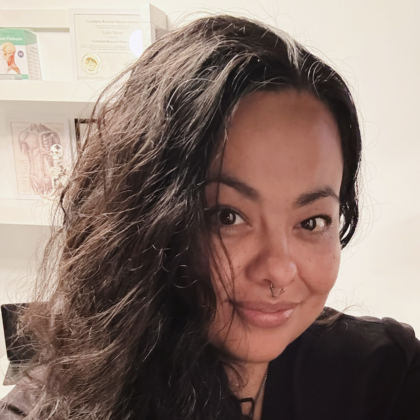
Edith Harris
About a year later, my phone rang and the screen said NHI. I almost didn’t answer. I knew exactly what the call was, and I had already decided I wasn’t going back. I picked it up anyway. It was Casey. Before he could even get into it, I said, “Is this my call back?” He said yep, we’re starting the next segment, you can come back. And in that split second, something in me changed. I said, let’s do it.
That second time around is when it actually happened. I fell in love with the work. The creativity of it, the clinical depth, the way it rewards curiosity and study. Somewhere in the middle of all that anatomy I once dreaded, something shifted. My husband has MS. I have fibromyalgia. The deeper I got into how the body actually works, the more I started to see it as a system I could finally understand.
Like a computer I could open up and look inside. I think about how I talk to my older clients about their phones. They’re afraid to press buttons because they think they’ll break something. I always tell them, you have this incredible piece of technology in your hand, go poke at it, explore it, you can’t break it.
And one day it hit me that I had been doing the exact opposite with my own body. I’d had it for forty plus years and knew almost nothing about it. I’d been afraid to look. Massage school made me look.
I didn’t just finish the program that time. I went straight from the Core program into the Advanced Neuromuscular Therapy program, and then into the Associate of Applied Science Degree program. Three programs back-to-back. The person who couldn’t show up to class became the person who couldn’t stop showing up.”
Building a Private Practice
I built a private practice, Knead Obscura, in Thousand Oaks that is intentionally clinical, intentionally serious, intentionally not what people picture when they hear the word massage. Part of why I built it that way is because I want this profession to be taken seriously in the medical field. I’m building referral relationships with dentists, physical therapists, and mental health providers, and the degree is part of why those conversations are even possible. We deserve that. Our clients deserve that.
 Once I finished the Core program, I knew I wanted to work with chronic pain and complex cases, not relaxation. Advanced Neuromuscular Therapy was the obvious next step. It’s where the assessment skills and clinical thinking really get built. It taught me to assess before I treat, to find the pattern instead of chasing the symptom. The thing the client is feeling is rarely the thing causing it.
The degree was the next decision. Massage therapy is still fighting to be respected in the medical field, and having an Associate of Applied Science behind my name matters. It gave me the tools to be the connecting piece, someone who can sit at the table with medical providers and specialists and help the puzzle make sense.
The bigger gift, though, was the biopsychosocial model of pain. Pain isn’t just tissue. It’s nervous system, history, stress, beliefs, environment. The degree gave me the language and the framework to treat the whole person, not just the muscles.
If a future student is reading this and you’ve been kicked out, or you’re in pain, or you don’t think you belong here, I want you to know two things. The first is that the instructor you think gave up on you probably didn’t. Casey didn’t. The second is that you’re allowed to come back. You’re allowed to pick up the phone.
I almost didn’t.
Military Discipline & Clinical Excellence (FAQ)
Q: How does a military background benefit a career in massage therapy?
A: Veterans like Edith Harris bring a unique level of discipline, focus, and empathy to their practice. These traits are essential in a clinical environment where attention to detail, following medical protocols, and professional conduct are paramount for patient success.
Q: What is the significance of the “Medical Massage Clinician” title?
A: This title signifies that a therapist has reached the highest level of vocational and academic training at NHI. By completing the Core, ANMT, and AAS Degree programs, graduates are prepared to work in integrated medical settings alongside doctors and specialists.
Q: How does the AAS Degree help in managing chronic pain?
A: The degree program focuses on the biopsychosocial model of pain, which views pain as a combination of biological, psychological, and social factors. This allows clinicians to move beyond just “treating muscles” and instead address the nervous system, movement patterns, and the whole person..
Meet more Neuromuscular Therapists and Medical Massage Clinicians from NHI.
Get the details on how to pursue a career in massage therapy and neuromuscular therapy with National Holistic Institute. Complete this form to connect with an admissions representative today.