Human Touch vs. Mechanical Touch: What the Science Really Says
- Advanced Neuromuscular Therapy Program
- Associate of Applied Science Degree Program
- Core Massage Therapy Training Program
- NHI Life
How the nervous system responds to hands-on care – and why skilled touch still matters
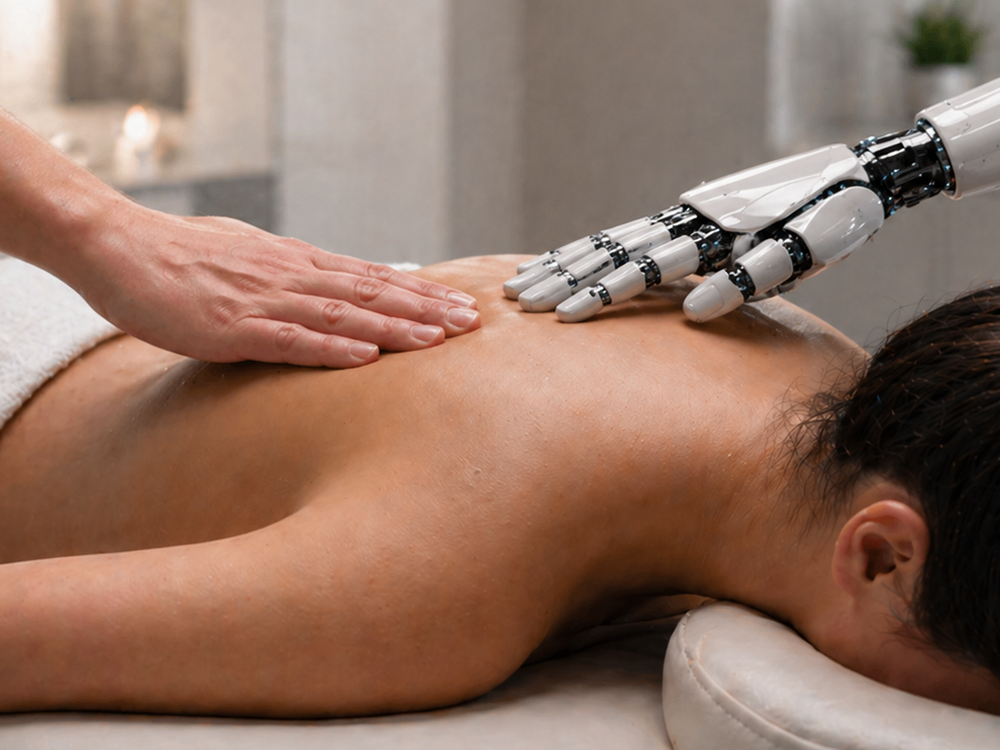
Human Touch vs. Mechanical Touch: What the Science Really Says
Content Summary
While massage tools and robotics offer convenience, they cannot replicate the biological necessity of human-to-human touch. This article explores the clinical science behind:
- The Science of Connection: How C-tactile afferents in the skin communicate directly with the brain’s emotional centers.
- Biological Feedback: Why the bi-directional communication loop between a therapist and client is essential for safety and deep healing.
- Clinical Reasoning: Why human intuition and empathy are the most powerful tools for down-regulating a sensitized nervous system.
Is All Touch the Same?
In our previous post, we explored a question that is being discussed more often in conversations with students, therapists, and even seasoned professionals: “Is Massage Therapy an AI-Proof Career?”
This leads us to a deeper and far more important question: Is all touch the same? If a massage gun applies pressure, if a foam roller compresses tissue, if a self-treatment tool creates a sense of “release,” is that truly equivalent to skilled human touch? After 25 years in practice, working with thousands of clients—including professional and elite athletes—and after years of teaching therapists how to assess and treat the body, I can tell you with confidence: it is not the same. Not because the tools don’t work (they do), but because they do not work in the same way as a knowledgeable, skilled massage therapist.
Touch is Not Just Pressure; It’s Information
One of the most common misunderstandings about massage therapy is that it is purely mechanical—simply pressure applied to tissue. The science behind touch tells a more complex story. The body is filled with sensory receptors, particularly within the fascia, that respond to different types of mechanical input.
Fascia: The Tensional Network of the Human Body by Robert Schleip explains that fascia contains multiple mechanoreceptors, including:
- Ruffini endings: Respond to slow, sustained pressure and are associated with relaxation.
- Pacinian corpuscles: Respond to vibration and rapid changes.
- Interstitial receptors: Respond to pressure and tension.
This distinction matters because different types of touch produce different neurological responses. In other words, not all touch is processed the same way by the nervous system.
What Mechanical Tools Actually Do
Massage guns, foam rollers, and self-myofascial release tools have become incredibly popular for good reason. They can create meaningful, short-term changes in how the body feels and moves. Research supports their effectiveness in specific ways:
- Increased local circulation
- Reduced perception of muscle stiffness
- Improved short-term range of motion
- Decreased soreness following activity
Studies such as Konrad et al. (2020) demonstrate that vibration can improve flexibility in the short term, while systematic reviews like Cheatham et al. (2015) show that foam rolling can temporarily increase range of motion and reduce perceived tightness.
These are real, measurable effects. However, these tools primarily deliver consistent, repetitive input and stimulate specific receptors. What they do not do is assess tissue quality, interpret what they are encountering, or adapt based on real-time feedback. This distinction is critical.
Human Touch Engages a Different System
Human touch is integrated, adaptive, and responsive. When a skilled therapist works with a client, multiple systems are engaged simultaneously:
- Mechanical input to tissue
- Sensory feedback from mechanoreceptors
- Interpretation of tissue tone and resistance
- Continuous adjustment of pressure and technique
- Verbal and non-verbal communication
- Regulation of the client’s nervous system
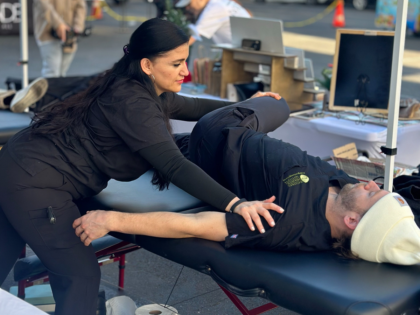
NHI Massage Therapy Student Stretching an Athlete at a Sports Massage Event
This is a real-time feedback loop. As described in Explain Pain Supercharged: “Pain is a protective output of the brain, not a measure of tissue damage.” Outcomes are influenced by context, perception, and safety—variables human touch can influence simultaneously.
Some Receptors Prefer Human Touch
Research by McGlone and colleagues has identified C-tactile afferents, nerve fibers that respond specifically to slow, gentle, human-like touch. These fibers are associated with:
- Emotional processing
- Social bonding
- Perception of comfort and safety
They do not respond in the same way to mechanical stimulation. This reinforces an important idea: who is touching you matters, not just how.
Adaptation is the Missing Variable
This is where tools, and even advanced technology, still fall short. A massage gun does not detect subtle guarding, adjust to changes in breathing, or shift approach when something isn’t working. A therapist does, and they do so continuously.
In Myofascial Pain and Dysfunction, the authors emphasize, “Palpation is the most important method of identifying myofascial trigger points and requires considerable practice to develop reliability.” This reliability is built through experience, repetition, and clinical reasoning—it is not pre-programmed.
Tools vs. Therapists: The Wrong Conversation
Let’s be clear; this is not about dismissing tools. Tools are accessible, efficient, and useful for self-care. They can play an important role in warm-up, recovery, and maintenance between sessions; but they are not a replacement for skilled care. A more accurate way to frame this conversation is: Tools apply pressure; therapists understand what that pressure means.
Why This Matters NOW
This distinction matters whether you are practicing massage therapy, preparing to enter the field, or receiving care. For therapists, it is a reminder that the future of the profession will not be protected by technique alone, but by assessment, adaptability, communication, and clinical reasoning.
For students, it reinforces why anatomy, palpation, body mechanics, and nervous system education are not just classroom requirements; they are the foundation of skilled therapeutic decision-making.
For clients, it offers a better question to ask: not simply, “how much pressure can you apply?” but, “Do you understand what my body is communicating, and can you adapt your care accordingly?”
The Bottom Line
Massage guns, foam rollers, and self-treatment tools are not the enemy of massage therapy. They are useful, accessible, and can absolutely support recovery and maintenance. But let’s be clear:
Applying pressure is not the same as delivering care.
All these tools and future mechanical massage applications can stimulate tissue, create vibration, and the algorithms that may be embedded within these tools can process information. But currently, none of them can:
- Interpret what the body is protecting
- Adapt to subtle physiological and emotional feedback
- Build trust through presence
- Integrate touch, assessment, and clinical reasoning in real time
That requires something far more advanced…a skilled therapist. As technology continues to evolve, the value of massage therapy will not be defined by who can create pressure. It will be defined by who can create understanding. The therapists who will lead the future of this profession are not those who simply perform techniques. The future of massage therapy lies in the hands of those that can:
- Think critically
- Assess thoroughly
- Adapt skillfully
- Continue learning relentlessly
In a world increasingly filled with automation, convenience, and mechanical solutions…human touch is not becoming obsolete. It is become more valuable, especially when backed by knowledge, skill, and clinical excellence. Tools may support the process. Technology may enhance the profession. But a therapist who can truly listen to the body with education hands is not something that can be mass-produced, automated, or replaced. This is exactly why higher education, advanced training, and clinical development matter now more than ever.
Build the Skill Technology Can’t Replace
If this perspective speaks to you, this is the moment to take the next step. Massage therapy is moving forward, and the therapists who will thrive are the ones who understand that great care requires more than pressure, tools, or memorized routines. It requires education. It requires assessment. It requires clinical reasoning. It requires the ability to adapt skilled human touch to the person in front of you.
At National Holistic Institute, students begin that journey through the Core Massage Therapy Program, where they build foundational knowledge and hands-on skills. For those ready to go deeper, the Advanced Neuromuscular Therapy Program provides focused training in assessment, clinical reasoning, pain patterns, neuromuscular techniques, and more advanced therapeutic decision-making. For students seeking a broader academic path, NHI’s Associate of Applied Science Degree Program offers an opportunity to continue developing as a more educated, capable, and future ready professional.
Whether you are just beginning your path, returning to deepen your skills, or looking for a program that takes massage therapy seriously as a meaningful healthcare-adjacent profession, NHI offers educational pathways designed to help you grow.
The future of massage therapy will belong to therapists who can think, assess, adapt, and care with intention. This biological advantage is exactly why massage therapy remains an AI-proof career.
If you are ready to become that kind of therapist, we invite you to learn more about NHI’s programs.
Common Questions About Human vs. Mechanical Touch
Q: Can a massage gun or robot replicate the benefits of human touch?
A: No. While mechanical tools can provide localized pressure and vibration to increase blood flow, they lack the ability to respond to “guarding” or subtle changes in muscle tone. Only human touch involves a bi-directional communication loop where the therapist adjusts their technique in real-time based on the client’s physiological feedback.
Q: What are C-tactile afferents and why do they matter?
A: C-tactile afferents are specialized nerve fibers in the skin that respond specifically to slow, gentle, human-like touch. These fibers send signals directly to the brain’s emotional processing centers, triggering the release of oxytocin and reducing cortisol. This “affective touch” is a biological requirement for deep nervous system regulation that machines cannot currently trigger.
Q: Why is “mechanical touch” less effective for chronic pain?
A: Chronic pain is often tied to a sensitized nervous system. Mechanical touch is predictable and repetitive, which can sometimes be perceived as a threat by an already stressed system. A skilled therapist uses clinical reasoning to provide “safe” input, down-regulating the nervous system and helping the brain “unlearn” pain patterns—a process that requires human intuition and empathy.
Bibliography
- Schleip, R. Fascia: The Tensional Network of the Human Body.
- Butler, D., & Moseley, L. Explain Pain Supercharged.
- Travell, J., Simons, D., & Simons, L. Myofascial Pain and Dysfunction.
- McGlone, F., Wessberg, J., & Olausson, H. (2014). Discriminative and Affective Touch.
- Konrad, A., et al. (2020). Effects of vibration therapy on flexibility and performance.
- Cheatham, S. W., et al. (2015). The effects of self-myofascial release: A systematic review.
About the Author

Phil Okazaki
Phil Okazaki is a massage therapist, educator, and an industry volunteer with 25 years of experience in the field and 17 years of teaching experience.
In addition to his educational experience of developing curriculum and mentoring therapists, he has several years of volunteer experience with the American Massage Therapy Association including 4 years as President of the AMTA California Chapter.
He has dedicated his career to elevating standards in massage therapy education and supporting the growth of the profession as an integral component of healthcare.
Phil is the Advanced Neuromuscular Therapy Program Manager at National Holistic Institute.
Get the details on how to pursue a career in massage therapy and neuromuscular therapy with National Holistic Institute. Complete this form to connect with an admissions representative today.